Organic Fruit and Veg, What Is It?
A Brief History
Welcome to our first blog post on our new website! Here we will try to fill in all the FAQ's and general background information about what organic fruit and veg growing is and why it's good for the planet and people. Organic farming as a set of principles and practices arose out of a movement founded by two main characters of the early 20th century in the UK, Sir Albert Howard and Lady Eve Balfour, Albert Howard worked as an agricultural advisor to the States of India from 1924-1931 and is famous for his 'Indore Composting' method. Lady Eve Balfour was a passionate farmer all her life having studied at Reading University College for the Diploma of Agriculture, being one of the first women to do so, she wrote 'The Living Soil' and co-founded the Soil association, becoming the first president of the now famous UK organic certifying body and campaign organisation. Both believed that feeding the soil with 'Humus' i.e. organic matter of various kinds, particularly when composted properly and using a variety of 'ingredients' in the composting mix, led to excellent soil health, translating into crop health and eventually human health when consumed. They also believed in species diversity on farms and the benefit in controlling crop pests, as latterly Albert Howard was very focused on studying the forest and it's ecological interactions, so as to mimic these interactions when farming as best as you could. 
Lady Eve Balfour
Organic Principles, Once Guidelines, Now Law
In 1946 the Soil Association was founded as a group of like minded farmers and interested parties who saw the mechanisation and industrial chemical 'green revolution' taking p[lace after the war and wanted to do things differently and learn from each other. With the Journal Mother Earth and later renamed Living Earth, members had a way to write articles, share experiences and agree/disagree with each other at annual meetings and conferences. Over the years of the 1970's and 1980's as interest in organic growing as a style of agriculture grew, members saw a need to police these standards in someway so a voluntary certification process with set of standards members agreed on where drawn up as to uphold the values and principles they held dear. The size of the market grew and grew and a need to properly police these standards was becoming more and more evident, so in the early 1990's Patrick Holden, Lawrence Woodward and their counterparts in many other nations worldwide helped draft and form legislation, that would enshrine in international law, a common set of standards all farmers and growers could sign up to in the UK, these standards would also be reflected in all other countries by a core set of codes, where farmers wished to grow 'organically' had to certify in their country in order call their produce 'organic', a monumental achievement if you ask me!
So now in 2024, what you get when you buy organically grown products, is a fully traceable system of production where traded food goods from around the world are checked for provenance annually by organic standards inspectors from the various nations these crops are grown. The body that oversees this co-operation and harmonisation of standards first convened in 1972 by Roland Chevriot, of Nature et Progrès, was called initially the International Federation of Organic Agriculture Movements, which now in 2024 is known as IFOAM- Organics International and includes over 100 member countries. As you can see from above video, there's a whole diversity of scales and methods, but common goals and practices that all organic farmers all over the world share.
Organic Fruit and Veg, Better For Nature, Better For You
We're now 100 years on from the first talks and publications of figures like Sir Albert Howard and Rudolph Steiner's series of lectures in Koberwitz, in 1924, famously the founder of Bio-dynamic agriculture in Germany, another important branch of the organic movement, and much scientific research and meta analysis of this research has been conducted. The results of meta analysis of biodiversity on organic farms have consistently shown a 30% greater diversity in flora and fauna on organically manged farms compared to their conventional counter-parts see Impact of Organic farming on Biodiversity by Martina Bavec and Franc Bavec and frontiersin.org article as examples. So it is widely accepted that organic farms can provide more habitat for a greater diversity of animal, insect and plant species, but what about nutritional value for the humans eating the organically grown fruit and veg? Well this area is more hotly contested and has a variety of factors that influence the nutritional quality and content per gram of the fruit and veg analysed, however some studies such as this one in pubmed by Walter J Crinnion clearly show higher levels of vitamin C, iron, magnesium, and phosphorus in the organic fruit and veg studied vs conventionally grown ones. Another study this time from the renowned Rodale Institute of The United States, a longstanding research institute into crop and soil health and organic agriculture, clearly makes the link between better soil health and crop quality, nutrient density and human called the power of the plate it makes a great case for differentiating between FOUR types of agriculture in the 21st century, Conventional, Regenerative, Organic and Regenerative Organic. Want to know what the difference is? Well skip to pages 11 and 19 in the study to learn what they summarise as the differences are... but suffice to say standards and farming methods can be differentiated in all four. See the Rodale institutes 40 year farming systems trail results here.
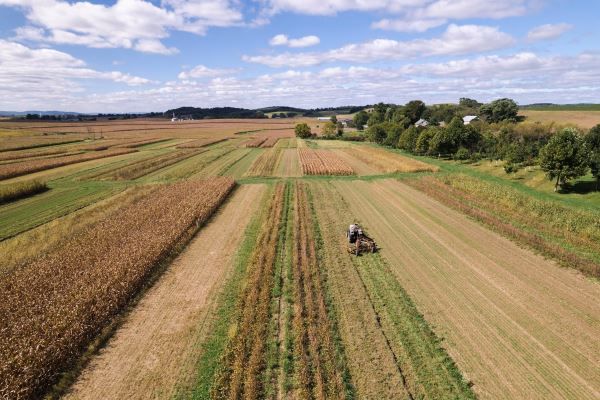
Above, Rodale Institutes 40 year Farming Systems Trial comparing Conventional , Organic Legume based and Organic Manure Based Field Management styles.
Summary, What is it Then?
Organic farming methods aim to not use synthetic pesticides, fungicides and herbicides and instead utilise organic matter derived 'inputs' in their farming system, such as compost, manure, molasses based plant liquid feed and pesticides made from naturally occurring plant or mineral compounds. Organic farms seek to provide a place for nature's diversity to co-exist on farms whilst balancing the need to provide fruit, veg and animal crops for human food. Whilst the methods and techniques used and scales they are deployed at are myriad and too exhaustive for me to go into any great detail here, there are core principles enshrined in international law, that all farms in all countries who have signed up to the IFOAM- Organic International trade standards, must abide by and be inspected annually to, in order sell and trade their products as 'Organic'. The Soil Association, Bio-Dynamic Association UK and Organic Farmers and Growers are the three main organic certifying bodies in the UK that have the IFOAM principles as their 'core' set of standards and all inspect to these standards, with extra detail and scrutiny paid to certain other certifying body specific 'extra' standards, depending on which organisation is certifying.


© 2026 - Sheffield Organic Growers
Powered by
